Assembly Bill 325
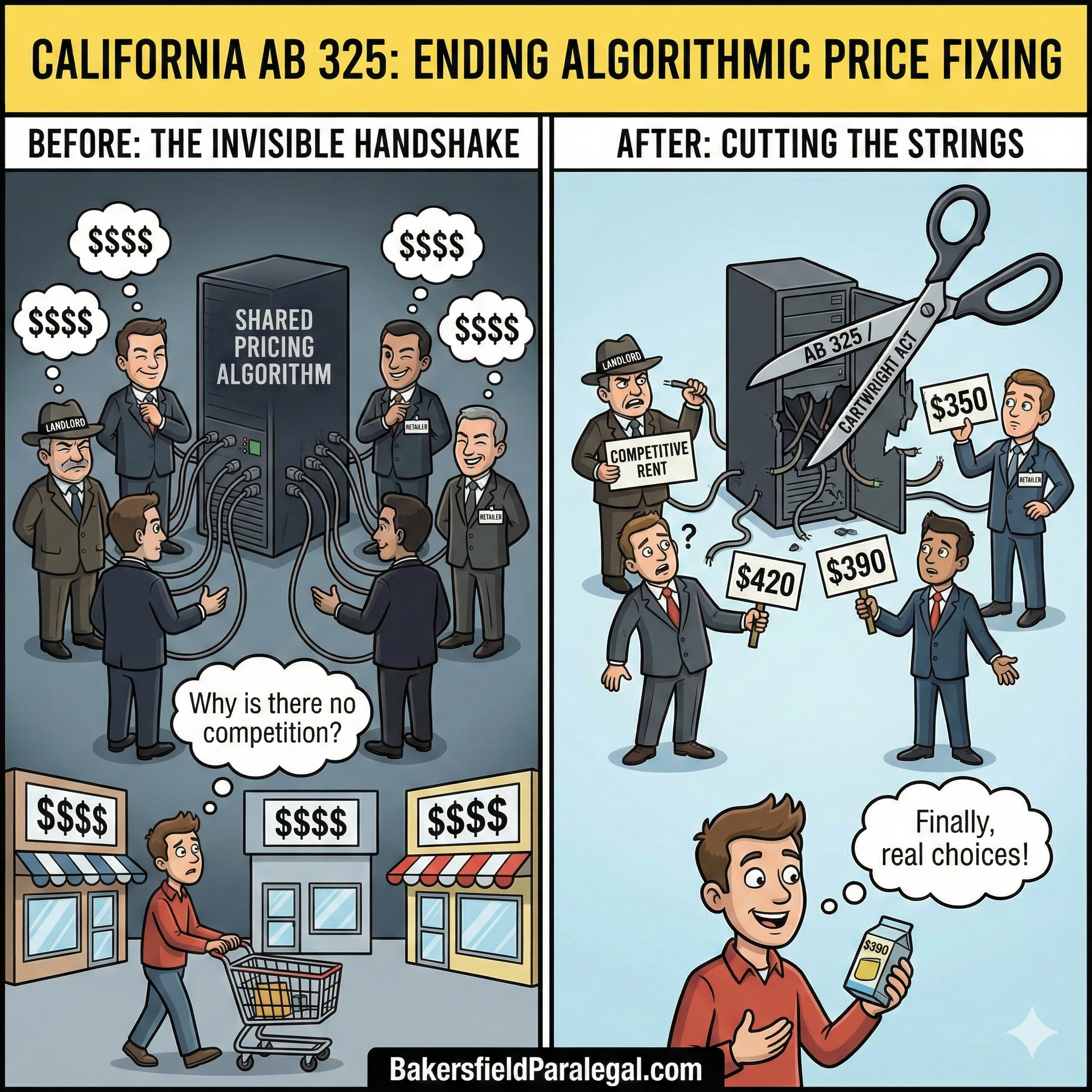
Cartwright Act: Algorithmic Pricing and Collusion
Authored by Assemblymember Cecilia Aguiar-Curry
Signed into Law: Oct 6, 2025 (Effective Jan 1, 2026)
Assembly Bill 325 updates California’s antitrust framework to explicitly prohibit “algorithmic collusion”—the use of shared software or computer processes to manipulate market prices. By closing loopholes in the Cartwright Act, the law ensures that businesses cannot use neutral-appearing technology to perform the same illegal price-fixing activities that would be prohibited if done in person.
1. Prohibiting “Common Pricing Algorithms”
- Restraint of Trade: It is now unlawful to use or distribute a “common pricing algorithm” as part of a contract or conspiracy to restrain trade.
- Defining the Tool: A “common pricing algorithm” is defined as any methodology or technology used by two or more persons that utilizes competitor data to recommend, align, or set prices and commercial terms.
- Data Inclusion: The law applies regardless of whether the algorithm uses public or non-public competitor data.
2. Liability for Coercion
- Standing Prohibition: AB 325 creates a standalone offense for coercing another firm to adopt a recommended price or commercial term generated by an algorithm.
- No Agreement Required: Unlike traditional antitrust claims, this “coercion” liability does not require proving a formal contract or conspiracy between the parties.
- Penalizing Non-Compliance: Conduct that penalizes a firm for declining to follow a recommended price is considered a violation under this provision.
3. Relaxed Pleading Standards
- Plausibility Standard: The bill lowers the legal threshold for bringing antitrust claims. A complaint is now only required to show that a conspiracy is “plausible”.
- Independent Action: Plaintiffs are no longer required to allege facts that specifically “exclude the possibility of independent action” at the early pleading stage.
- Increased Litigation Access: This change makes California state courts a more permissive venue for antitrust conspiracy claims compared to federal courts.
Impact Summary
AB 325 strikes at the heart of modern “contactless” price coordination, particularly in industries like rental housing and e-commerce where shared pricing aggregators are common. By establishing these new categories of liability and lowering the hurdle for filing lawsuits, California aims to protect independent businesses and consumers from “rigged” markets. While it does not ban pricing software itself, it holds businesses accountable for how they use shared data to influence the cost of living for California families.